 |
| Long Lane, Oil on Board 12" x 10" |
Showing posts with label Horton-in-Ribblesdale. Show all posts
Showing posts with label Horton-in-Ribblesdale. Show all posts
Monday, 31 October 2016
Long Lane


Monday, 17 September 2012
Forging a Path
Last year, when we had a summer, we took a number of photos of the kids at play in the fields around the house. A nice, simple composition which utilises light effects rather than detail, I painted this one on a crimson ground as there is not much of that primary in the painting itself, and I hoped to conteract this by using red as a ground, and occasionally it filters through.

The light streaming through the trees was a last minute addition, having showed the 'completed' image to the wife, she asked "is it finished?" as the initial composition had a break in the trees through which the sky could be seen, and when this was portrayed on canvas had the resemblence to a very pale sky-blue blob in the middle of the trees (her words, not mine)... I had to agree with her, it looked - well wrong. So I scraped back the blob, darkened it out and slapped in some lime green which I smeared across the canvas, all of this must have taken about 15 minutes, from her appraisal to the finished article. It just shows what can be achieved given the need.

"Forging a path" Oil on canvas 20" x 16"
The light streaming through the trees was a last minute addition, having showed the 'completed' image to the wife, she asked "is it finished?" as the initial composition had a break in the trees through which the sky could be seen, and when this was portrayed on canvas had the resemblence to a very pale sky-blue blob in the middle of the trees (her words, not mine)... I had to agree with her, it looked - well wrong. So I scraped back the blob, darkened it out and slapped in some lime green which I smeared across the canvas, all of this must have taken about 15 minutes, from her appraisal to the finished article. It just shows what can be achieved given the need.
Friday, 30 March 2012
Stone Sentinel, Moughton
Between Crummackdale and Ribblesdale is an upland block of Carboniferous limestone overlying Silurian siltstone, part of the Ingleborough massif called Moughton, which I believe is translated as 'pile of rocks'. The unconformity (between the Silurian and the Carboniferous) is of huge interest to the geologist where the limestone is horizontally-bedded on top of the steeply-dipping Silurian siltstones; the limestone on top of the plateau is of interest to the botanist also with numerous (sometimes rare) calciphiles inhabiting the cracks (grykes) between the limestone blocks (clints). The area is one of peace and solitude and a wonderful place to relax and chill out (quite literally).

The first time I explored the area I came across this stone structure, this cairn sits atop the limestone pavement near Long Scar, being in that frame of mind I considered it then, and wondered why someone had gone to the time and effort of building it. It stands about 6ft high, and is obviously of some antiquity given the amount of lichen / moss growth, it could be a waymarker - as there is a safe route down Long Scar not so far away from it, but it's still a distance away - personally I like to think it was built by some bored shepherd as a walling 'apprentice-piece'.
On a very (very) cold day last November I decided to go for a bit of a paint, (and spurred on having read one of David Bellamy's books intimating at painting in all weathers - although I draw the line at rain and snow) and equipped with my pochade box I climbed the path close to Dry-Rigg Quarry and onto the Moughton uplands. It was perishingly cold, but hugely relaxing, and as I was slapping the paint onto the pochade a stoat came out of hiding to have a look what I was doing, normally I don't like visitors, but I didn't begrudge the curiousity of a stoat.
I wasn't originally planning on this one being a 'biggie', but with a moment of inspiration I had a bash at it, changing the compsition somewhat through the process of the painting. Having painted it I know what I could do better and if I re-do this or painting some more limestone scenery I will be able to apply these technique changes.
 The Stone Sentinel, Moughton Oil on canvas 18" x 14"
Regardless I like the feeling of solitude and drearyness (again), and I am certainly inspired enough to have another bash at Moughton's karst landscape. I reccomend anyone to go there and experience the lunar landscape, it has a feeling all to its own.
http://www.davidbellamy.co.uk/

The first time I explored the area I came across this stone structure, this cairn sits atop the limestone pavement near Long Scar, being in that frame of mind I considered it then, and wondered why someone had gone to the time and effort of building it. It stands about 6ft high, and is obviously of some antiquity given the amount of lichen / moss growth, it could be a waymarker - as there is a safe route down Long Scar not so far away from it, but it's still a distance away - personally I like to think it was built by some bored shepherd as a walling 'apprentice-piece'.
On a very (very) cold day last November I decided to go for a bit of a paint, (and spurred on having read one of David Bellamy's books intimating at painting in all weathers - although I draw the line at rain and snow) and equipped with my pochade box I climbed the path close to Dry-Rigg Quarry and onto the Moughton uplands. It was perishingly cold, but hugely relaxing, and as I was slapping the paint onto the pochade a stoat came out of hiding to have a look what I was doing, normally I don't like visitors, but I didn't begrudge the curiousity of a stoat.
I wasn't originally planning on this one being a 'biggie', but with a moment of inspiration I had a bash at it, changing the compsition somewhat through the process of the painting. Having painted it I know what I could do better and if I re-do this or painting some more limestone scenery I will be able to apply these technique changes.

Regardless I like the feeling of solitude and drearyness (again), and I am certainly inspired enough to have another bash at Moughton's karst landscape. I reccomend anyone to go there and experience the lunar landscape, it has a feeling all to its own.
http://www.davidbellamy.co.uk/
Monday, 13 February 2012
Barns
Barns.
 I have sketched and drawn numerous barns around the vicinity (of Horton), and there are hundreds to choose from, and in this post I have thrown in a few of my sketches. I suppose like sheep and walls they are another ubiquitous symbol of the Dales, but sadly a lot are in disrepair - the maintaining and rebuilding costs of the barns far outweigh their use. Originally these laithes were used for the overwintering of cattle and fodder storage, they are numerous so the heavy items (hay) did not have to be transported far from where they were harvested, and manure from the cattle over winter could be spread on the nearby fields. However with modern agricultural techniques, transportation of materials is far easier therefore reducing the necessity of numerous barns.

But as ruins in themselves these have a strangely romantic quality, and aside from being practical buildings they stir imaginations, why is this? What is it about ruined barns that drags us in, what is it about these weather-worn broken-down buildings?
 In the landscape of the Pennines (away from my local area) the barn is depicted as a black monolith at the conjunction of black walls against a field of yellow ochre, with a feeling of tempest in the air. Two words in literature echo this emotion, Wuthering Heights.
The paintings of Peter Brook mirror this feeling, his depiction of the field barn in the landscape epitomises the West Yorkshire Pennines, especially those painted against a winter scene, they have a true 'Yorkshire' feeling about them. One can look at a Peter Brook image of a barn in winter and automatically place the part of the county it depicts, and it is interesting to note Peter Brook commonly used sand mixed in with his paint which added extra texture to his paintings.
 So because of these barns were built using locally available material (avoiding transportation costs), they reflect the local geology and therefore mirror the landscape of their surroundings. Where I live, in the heart of Limestone Country, the barn takes on a different persona. Local limestone is used for the walls and laithes and overall appears as a much brighter, lighter (dare I say it, a 'happier') place than the brooding sandstone and gritstones of the southern Pennine scenery.
http://www.peterbrookart.co.uk/
Wednesday, 12 October 2011
Swaledale Ewe
Thinking of a catchy title for a sheep is not an easy task for it not to sound to cheesy, painting it however was a dream. It was one of those paintings I completely lost myself in, starting first with the head and the facial details, going mad with the fleece, and then almost as an afterthought the blurred walls, and finally the grass. I guess this isn't the proper way around a canvas, but hey, I'm enjoying it, and no-one has ever told me the rules so I guess there are none to be broken.
 "Are ewe looking at me?" Oil on Canvas 18x14"
For those who are interested, she is another swaledale ewe, the same sheep in fact as the previous posting of 'steves sheep' (yeah another catchy title), painted from a photo (another slap on the wrist) over a number of weeks (but only three sittings, which were orientated around work). I remember saying something about sheep and walls, and clichee... can't quite remember what... but regardless, the sheep in question evolved from the fact that I really enjoyed my previous sheep experience, and I think she's a winner.
I've got a few more projects on the go, but as I'm away for the rest of October and most of November I may just update this site with some previous paitings.
Sunday, 11 September 2011
Jacky Barn
Another fantastic summer’s day and another opportunity to get out and record another part of the countryside, in fact it was probably the zenith in terms of weather for this summer in this part of England. Salaber’s Barn (locally known as Jacky Barn) is a typical stone-built Dales’ Barn just off the Pennine Way track past the Crown Inn, Horton. These stone barns adorn many a landscape painting of the area, but rarely as a study in themselves. I find them incredibly interesting, each Dale seems to have its own style, in terms of layout and this one is typical for North Ribblesdale. The workmanship of some of these barns is simply outstanding, and there are hundreds scattered all over the place, some are in a sorry state of repair. No worries (I thought) about people looking over myshoulder at this one, as I plonked myself down in a fairly empty field, empty that is apart from the sheep.
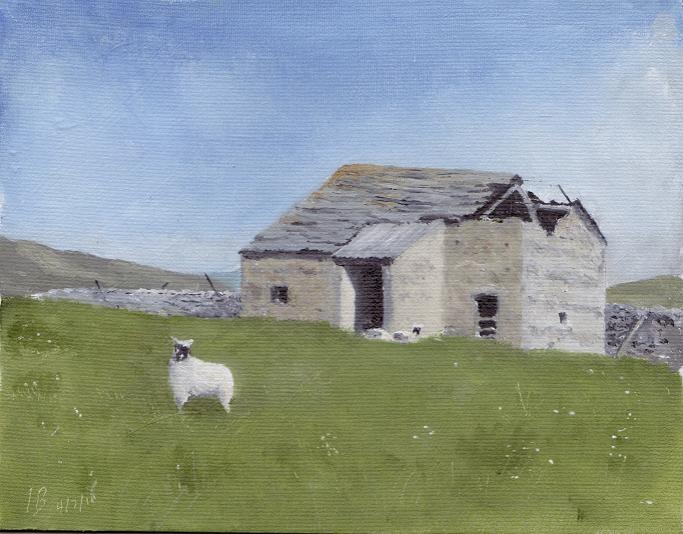
"Jacky Barn" 8"x6" Oil on board
I found painting this one fairly easy, and rather enjoyable, and I was completely oblivious to how hot the sun was. This ended in burnt legs and arms, again I learned another (painful) lesson, one which I am bound to repeat… Half-way through the pochade the sound of a quad-bike, cursing and sheep calls broke out. I should have realised that most of these sheep in this field had yet to be shorn, and up rolls Steve with his dogs rounding up the sheep, not an easy task as I know how stupid sheep are, but the dogs set to the work effortlessly. He had a long look at the painting and as it was clearly unfinished he took a breath, and asked if there was any chance I could paint the complete roof, as it was one thing on his long to-do lists… the time of day was passed and he was off on his way. That’s the thing about painting in the open, anyone passing will not be aware of what stage the painting is at and therefore won’t pass comment, and if they do it’s always positive. I implore people to get out and paint, and not to be put off by what others think. I know artists who work predominantly from photos, and I think they are missing a whole part of the spectrum, but yes it does take nerve to ‘perform’.
The sheep in the foreground was just a memory by the time I painted it in, and I think I have done it justice. Overall the pochade took about 2 hours, and to be honest I never felt any time passing.
Friday, 19 August 2011
Summer Pen Y Ghent
Pen-y-Ghent is an iconic hill in the dales, its shape is discernible to all those who know the region, and especially those who have walked up its slopes. The translation of the Gaelic is Hill of the Winds, and is aptly named as it never ceased to blow atop its summit. Being likened at various angles to the back of a whale, an upturned pie, and even a baboon's head; the hill is certainly a focal point for all images of the upper stretches of the Ribble. There are really two hills in one, the main, highest hill is Pen-y-Ghent itself which doglegs away from the river with the smaller, less frequented Plover Hill on the massif's northern slope. A gritstone monolith overshadowing the softer shales and limestones of the Yoredale series, is a remenant of the ice ages which ravaged this part of yorkshire thousands of years ago. Along with its sisters, Ingleborough and Whernside make up the Yorkshire three peaks, this would be the baby of the three, not the highest, but arguably the prettiest.

I painted a pochade in a morning when it stopped raining long enough for me to rush out of the house and complete a sketch in about an hour and a half. The lane is one which leads from Crooks Farm to the main B6479 road, and is typical of the lanes herabouts. South is to the right in the picture and it is interesting to note the fauna along the north side of the path (facing south) is meadowsweet, cow parsley, buttercups and hogweed. The other side of the path is dominated by grasses - these sort of things I onnly note when I am painting the picture.
I liked the scene immensly and wanted it more refined and certainly on a larger scale. I used a 24 x 18" canvas for the finished painting and rather than getting it done in a day spent about a week on the process. Using the Artisan water mixable oils, I have found that to get them to dry so that overpainting is reasonably workable takes about a day and a half. I wasn't aware of the final composition as I was going along and the character (my wife) was chucked in on a whim without any forethought for balance - and yes I am aware I have broke one of the cardinal sins of composition - in that I have a subject matter dead center, this certainly was not my aim although it is growing on me.

And a photo I took while painting the pochade...

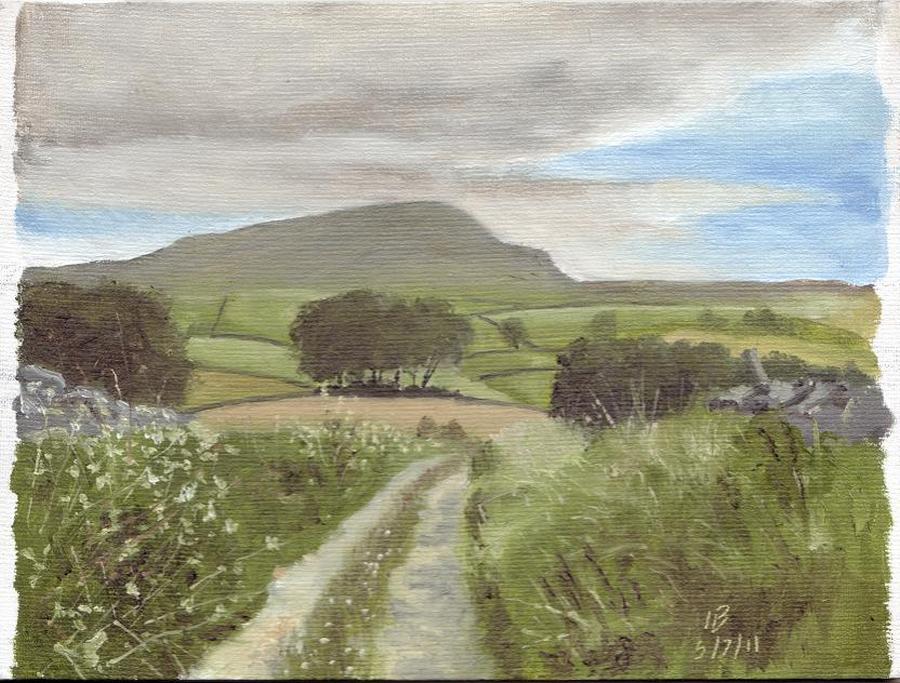
I painted a pochade in a morning when it stopped raining long enough for me to rush out of the house and complete a sketch in about an hour and a half. The lane is one which leads from Crooks Farm to the main B6479 road, and is typical of the lanes herabouts. South is to the right in the picture and it is interesting to note the fauna along the north side of the path (facing south) is meadowsweet, cow parsley, buttercups and hogweed. The other side of the path is dominated by grasses - these sort of things I onnly note when I am painting the picture.
I liked the scene immensly and wanted it more refined and certainly on a larger scale. I used a 24 x 18" canvas for the finished painting and rather than getting it done in a day spent about a week on the process. Using the Artisan water mixable oils, I have found that to get them to dry so that overpainting is reasonably workable takes about a day and a half. I wasn't aware of the final composition as I was going along and the character (my wife) was chucked in on a whim without any forethought for balance - and yes I am aware I have broke one of the cardinal sins of composition - in that I have a subject matter dead center, this certainly was not my aim although it is growing on me.

And a photo I took while painting the pochade...

Thursday, 4 August 2011
Steves Sheep
Oil on canvas, 12x9". She's a Swaledale ewe belonging to a friend of ours painted yesterday. I have always maintained that if you can paint sheep and walls you've made it as an artist in the dales, so as you can tell I'm getting there... (I'm not too happy about the wall). I know the composition is a bit wacky and goes against all of the rules written down on composition, but sometimes I think what the hell, I like this and there's something about it that works.

I know it's a bit clicheed, the ubiquitous sheep and the wall, but really thats the reality of life in the dales, it opitomises life in the dales and not to paint them would miss out on a huge portion of the feeling of the region. So apologies for the clichee... I was thinking last night about painting a similar subject but much larger, however I feel I may be falling into the trap of the stereotype.

I know it's a bit clicheed, the ubiquitous sheep and the wall, but really thats the reality of life in the dales, it opitomises life in the dales and not to paint them would miss out on a huge portion of the feeling of the region. So apologies for the clichee... I was thinking last night about painting a similar subject but much larger, however I feel I may be falling into the trap of the stereotype.
Friday, 8 July 2011
Pochades
Last week I made a concious effort to improve my painting, to attempt at least to do something arty every day while I am at home. We live in the dales and as it was summer last week (yes, for one or two weeks a year) I decided to get out of the house with my dusty pochade box and get painting.
It started off at a sterling pace, I managed to thrash out 2 pochades in the first day of my resolution, although I have to admit by the end of that day I just wanted to get the painting finished and to head off home.


The view in the first is towards the "Tay Bridge" through Crooks pasture, Horton-in-Ribblesdale. I guess its called locally as the Tay bridge because its predecessor got washed away some time ago, and the new bridge was built about 20 years ago. As the day was wonderfully hot, and dry weather forecast, I wanted to get the scene in before the farmer cut the grass for silage (which happened the very next day). I positioned myself across the small back (which is just in the foreground) away from prying eyes from the footpath which runs across the field. I don't know why I settled on this composition, I guess I have always found it pleasing and any path which takes you towards a bridging point is aesthetically pleasing (not that I am spiritual in any sense of the word!).
The painting is on an 8x6 canvas board (one of 7 remaining), and painted with water mixable oils, these are quite handy when out and about. I tried to get it thrashed out as quickly as possible, but it still took 1 1/2 hours to complete. Perfect I reckon as an oil sketch for a future painting?
Subscribe to:
Posts (Atom)